
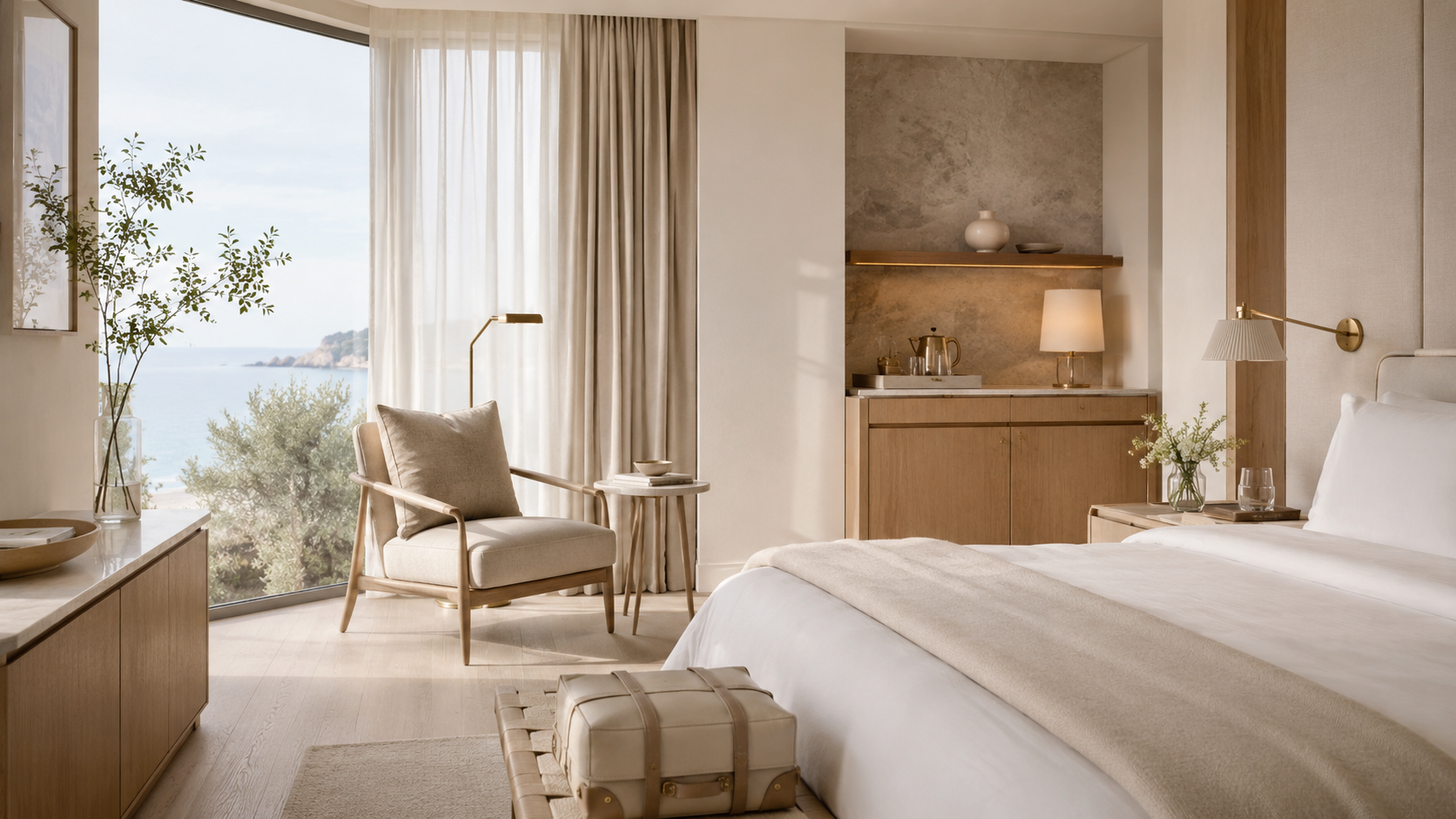
You often feel the difference before you have understood it.
A hotel entrance closes behind you. The noise of the street softens, the light changes, and the route ahead seems clear without requiring explanation. There is somewhere to pause, somewhere to place a bag, and someone visible without being imposing. The building appears to know that you have arrived before you have learned anything about it.
This is part of what makes luxury hotel interiors feel different. The effect does not come from expensive furniture alone, nor from rare stone, dramatic lighting or polished metal considered separately. Many costly rooms remain awkward or difficult to inhabit. What distinguishes the most convincing hotels is their ability to make an unfamiliar place feel understandable almost at once.
A home becomes comfortable through knowledge accumulated over time. We know which switch controls which light, how the door closes and where everything belongs. A hotel guest arrives without any of this familiarity. The room must communicate itself quickly, quietly and without demanding too much attention.
Luxury hospitality design is therefore an art of anticipation. It considers not only what the guest will see, but what they will need before they have had to ask.
The Choreography of Arrival
A hotel begins before the reception desk.
The entrance establishes the first relationship between guest and building. The depth of the threshold, the movement of the door, the direction of the light and the first view across the lobby all influence how arrival feels. These decisions guide the body before the mind begins to analyse the interior.
This matters because guests rarely arrive in a neutral state. They may be tired, hurried, carrying luggage or uncertain of local customs. Good hotel interior design reduces that uncertainty in stages.
The route from door to reception should be visible without becoming theatrical. Luggage should not turn the entrance into an obstacle course. A place to sit should be apparent without resembling a waiting room. The architecture must offer orientation while preserving a sense of welcome.
The best arrivals are not necessarily grand. A small hotel may achieve the same effect through a well-placed desk, a change in flooring, a pool of warm light or a member of staff who can approach naturally. What matters is that the guest does not have to decode the room.
The first expression of luxury is often confidence: the feeling that the next action is obvious.
Making an Unfamiliar Room Legible
Hotel rooms must be distinctive enough to feel memorable, yet clear enough to be understood by someone who may stay for only one night.
A visually impressive room can fail within minutes if its basic actions are obscure. Curtains that require experimentation, switches that operate unexpected fittings, a wardrobe hidden behind decorative panelling or a bathroom door mistaken for a cupboard all create small moments of uncertainty.
None of these difficulties is catastrophic. Their effect is cumulative. The guest begins to feel that the room must be managed rather than inhabited.
Legibility comes from placement, hierarchy and familiar physical cues. A bedside light should be controlled from the bed. A socket should be reachable without moving furniture. Luggage should have a place that does not block circulation. The route to the bathroom should remain clear in low light.
Successful luxury hotel interiors allow the guest to learn the room through use. Surprise can belong to atmosphere, view or material, but not to the basic mechanics of living.
The Architecture of Comfort
Comfort is often confused with softness. In hospitality, it is better understood as space arranged around human actions.
A generously upholstered chair can remain uncomfortable if it gives no support. A large bedroom may feel ungenerous if there is nowhere to open a suitcase. A luxurious bathroom can frustrate if dry clothes have no safe place to rest.
Real comfort depends upon proportion, reach, temperature, movement and choice. There should be enough room to pass around the bed without turning sideways. Two guests should be able to use the room without repeatedly negotiating the same narrow path. A chair near a window should have sufficient light for reading, while someone sleeping should not be disturbed by every lamp in the room.
These allowances are rarely spectacular. They appear as a little more surface beside the bed, a bench positioned where luggage is naturally opened, or a bathroom shelf deep enough to hold what a guest actually carries.
Comfort also involves degrees of privacy. A lobby needs openness, but not total exposure. A guest should be able to sit alone without feeling isolated, or hold a conversation without becoming part of the room’s general performance. Architecture achieves this through changes of scale, seating orientation and the careful use of distance.
A room feels generous when it gives people options.
Light, Sound and Sensory Calm
Hotel atmosphere is created as much through the senses as through visible style.
Guests use the same room for arriving, dressing, reading, working, sleeping and waking. A single level of illumination cannot support all of them well. Ambient light establishes calm, focused light supports reading, and low-level light makes movement at night possible without fully waking the room.
The controls must remain simple. A complex lighting scheme that cannot be understood becomes an elaborate inconvenience. The guest should not need to test every switch before going to bed.
Sound carries equal importance, although it is less visible in photographs. Corridors, doors, lifts, plumbing, music and mechanical systems can quietly determine whether a hotel feels restful or exposed. Hard surfaces may look immaculate while sending footsteps and conversation across an entire floor.
Acoustic comfort does not mean silence. A bar should have energy and a lobby should feel inhabited. The task is to keep sound at the scale of the activity. Calm is produced by controlling what reaches the guest, not by removing all signs of life.
Materials Under Constant Use
Hotels test materials more intensely than most private interiors.
Floors receive luggage, shoes, cleaning equipment and constant circulation. Handles are touched by hundreds of unfamiliar hands. Tables meet water, cosmetics, food and repeated cleaning. Upholstery is compressed, moved and maintained according to schedules rather than personal habit.
For that reason, material selection in luxury hospitality design cannot be based on opening-day appearance alone. A surface must remain convincing after contact becomes routine.
In Material Honesty in Design, we considered the importance of allowing materials to retain their own character. Hospitality extends that argument by adding endurance. Stone should tolerate the place in which it is used. Timber should be detailed so that wear does not immediately appear as neglect. Leather should soften rather than collapse. Brass should be specified with an understanding of whether it will be polished, allowed to patinate or regularly restored.
The most successful materials do not merely survive use. They absorb it in a way that remains visually coherent.
This does not mean every surface must display age. Some spaces depend upon crispness and exact maintenance. The important question is whether the material and the maintenance strategy agree. A finish that requires constant concealment of ordinary contact will eventually make the room feel fragile.
The Small Points of Contact
Large spaces establish the character of a hotel, but small objects often determine how that character is experienced.
A switch, latch, hook, rail, drawer pull or reading lamp occupies little visual territory. Each is encountered through an action. These details sit between the body and the room.
As explored in The Forgotten Beauty of Utility, useful objects often disappear when they work well. In a hotel, their importance is heightened because the guest cannot rearrange the room to correct them. At home, a lamp can be moved or another hook added. In a hotel, the guest must live temporarily inside decisions made entirely by others.
A bathroom without a sensible place for a towel exposes a gap between appearance and use. A bedside table with no accessible charging point tells the guest that the photograph mattered more than the night. A heavy door fitted with an insubstantial handle produces a small but persistent mismatch.
The weight, movement and placement of architectural hardware contribute to the interior long before they are noticed as objects. This same attention informs the pieces considered by The Brass Store, where handles, hooks and fittings are understood as part of daily experience rather than final embellishments.
The Hidden Architecture of Service
A hotel is both an interior and a working system.
Behind the bedrooms, restaurants and lobbies are housekeeping routes, storage areas, kitchens, service lifts, linen rooms and maintenance access. The apparent ease of hospitality depends upon this hidden organisation.
Poor planning eventually becomes visible. Trolleys gather in guest corridors. Deliveries cross arrival routes. Temporary storage appears in public rooms. Staff must improvise around decorative choices that ignored the work required to sustain them.
Good planning allows service to occur with dignity and efficiency. Reception feels approachable because staff can move naturally around it. Rooms can be cleaned without furniture becoming an obstacle. Breakfast service can expand and contract without dismantling the room’s composure.
A hotel that supports its staff is more likely to offer calm service because the building is not continually resisting the work. The design anticipates not only the guest’s needs, but the labour through which those needs are met.
A Sense of Place Beyond Decoration
The phrase sense of place is used so often in hospitality that it can lose meaning.
Local artwork, regional craft and familiar materials can all contribute to identity, but they do not automatically root a hotel in its setting. A decorative reference may remain superficial if the building ignores climate, street, landscape and local patterns of life.
Place is expressed through how the hotel behaves. In a hot climate, shade, ventilation and transitions between inside and outside may matter more than decorative motifs. In a dense city, the relationship between entrance and pavement can determine whether the hotel feels connected or sealed away. In a historic building, irregular rooms and inherited details may offer more character than imposed uniformity.
Views also create belonging when they are framed with intention. So do courtyards, changes in daylight, local stone used where its physical qualities are relevant, and furniture produced by craftspeople who understand the region’s materials.
A hotel belongs somewhere when removing it from that place would weaken its logic.
This connects to the definition proposed in What Is Luxury? A Radical Definition. Genuine luxury often depends on qualities that resist easy duplication. Climate, history, workmanship and setting can produce a form of rarity that styling alone cannot imitate.
The Memory of Temporary Rooms
People rarely remember a hotel room as a complete inventory.
They remember the morning light, the quietness of the night, the chair beside the window or the ease with which they could settle after arriving. These memories are created through temporary routines. A suitcase is opened. Clothes find a place. The same lamp is used each evening. A view is checked each morning.
For a short period, an unfamiliar room becomes the setting for ordinary life.
This is why novelty must be handled carefully. A hotel should offer something beyond the everyday, but excessive novelty asks the guest to remain continually alert. The most memorable rooms balance distinction with immediate usability.
They give the guest enough character to remember and enough clarity to relax. The deeper success is that, within a short time, the guest stops feeling like an intruder within the room.
Hospitality as Anticipation
Luxury hotels feel different because they anticipate needs before those needs become interruptions.
The entrance offers orientation. The room explains itself. Light and sound support changing states of attention. Materials withstand real use. Small objects assist the body. Service is supported by the building rather than concealed through effort. The hotel belongs to its setting without turning place into decoration.
These decisions are connected by one principle: the guest has arrived without knowledge, and the interior must bridge that gap.
This is why copying the visible style of a successful hotel rarely recreates its atmosphere. The same stone, colours, furniture and metal finishes can be assembled elsewhere, yet the result may feel strangely empty. What is missing is the network of judgements that made the original place comfortable, legible and specific.
Luxury hospitality is the creation of confidence in unfamiliar surroundings.
The finest hotels do not remove every difference between travel and home. They preserve the pleasure of being somewhere else while removing the uncertainty that prevents someone from settling.
For a little while, the guest understands the room, and the room appears to understand the guest.
That is why it feels different.
Continue Reading
Presented by The Brass Store