
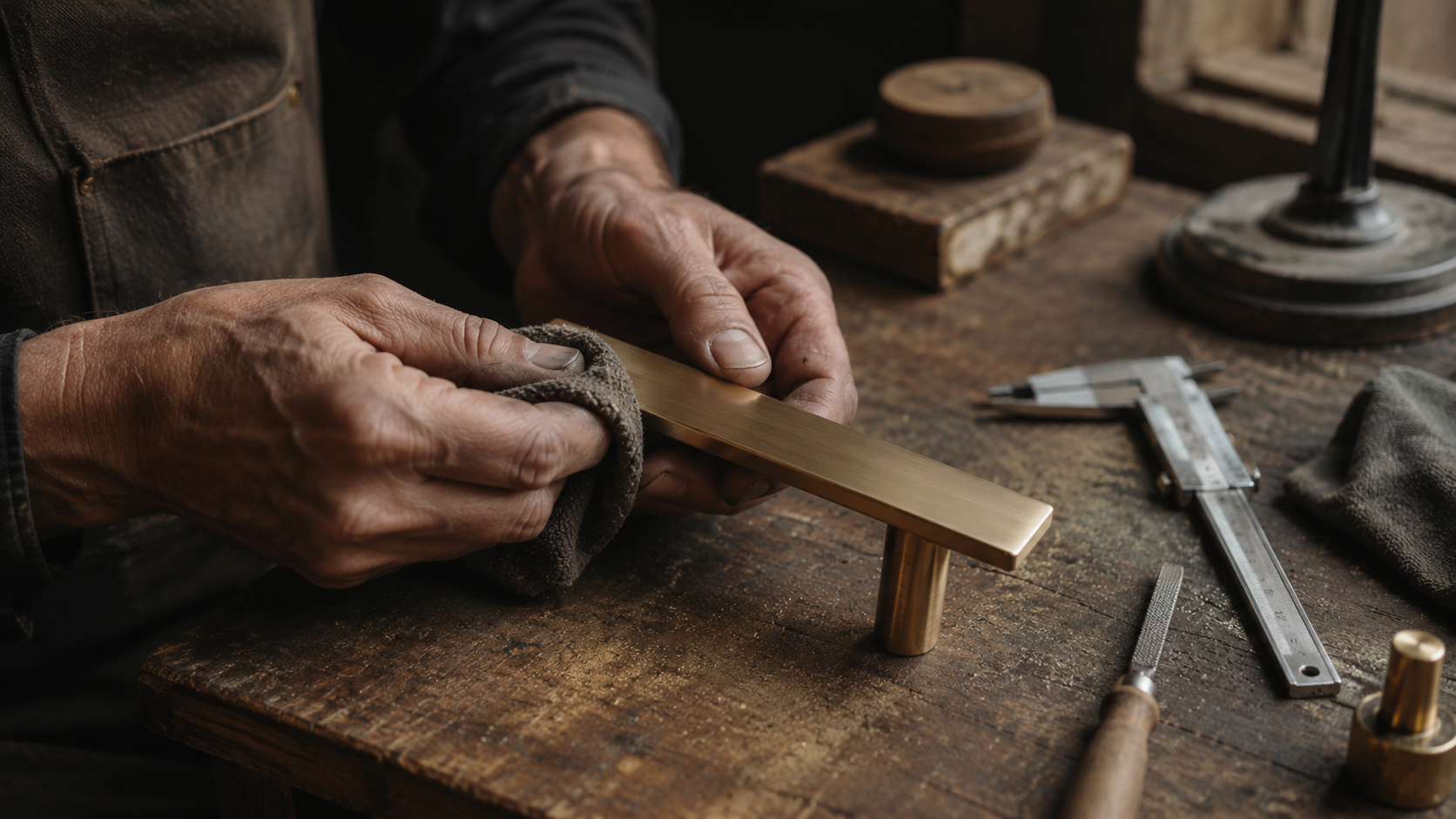
Before a brass handle leaves a workshop, it may have passed through a mould, a cutting tool, a file, a polishing wheel and several pairs of hands. Much of this work can be planned in advance. Its dimensions can be specified, its finish sampled and its production sequence repeated. Yet there is usually a moment when the plan stops being enough.
The casting may be sound, but the balance may feel slightly wrong. A hinge may move, but with too much resistance. A darkened finish may have settled beautifully into one recess and too heavily into another. Someone must notice the difference and decide what to do next.
The modern world is exceptionally good at producing objects quickly, reliably and in large numbers. That achievement should not be dismissed. Mass production has made well-designed, useful things available to people who could never have afforded individually made equivalents. Precision machinery can perform certain tasks more consistently than the human hand ever could.
But consistency and craftsmanship are not interchangeable. Handmade still matters because making is not always a sequence of instructions. Sometimes it is a sequence of decisions.
What Handmade Actually Means
The word handmade is often treated as the opposite of machine-made. In practice, the boundary is far less tidy.
A contemporary craftsperson may use casting equipment, powered tools, mechanical presses, lathes, laser measurements or computer-guided cutting. A cabinetmaker does not become less skilled because timber has been prepared by a machine. A metalworker does not stop practising a craft because a mould has been used to establish the initial form.
What matters is not whether machinery entered the workshop. It is whether responsibility remained with the maker.
A genuinely crafted object passes through stages at which a person can assess, intervene and refuse. The maker can decide that a component should be worked again, that a finish has become too uniform, or that an apparently minor flaw will affect the object after years of use. They are not merely operating a process. They are answerable for its result.
Handmade, understood properly, is therefore less about the absence of technology than the presence of authorship. It means that somewhere within the making, a person had both the authority and the knowledge to say: this is not ready.
Where Repetition Ends
Machines are excellent at repeating an established decision. Once a form, measurement or movement has been programmed correctly, the same action can be performed thousands of times with extraordinary accuracy. For components that must fit together, this reliability is invaluable.
The difficulty is that materials and objects do not always arrive at the final stage in identical condition.
A timber joint may need adjustment because the grain has moved unexpectedly. A ceramic vessel may appear level until it is placed on a flat surface. The resistance of a hinge may change after its finish is applied. Two cast brass pieces from the same mould may require slightly different work before their surfaces respond to light in the same way.
A production system can identify many of these differences, but craftsmanship begins with the ability to interpret them. The maker must understand whether a variation is harmless, whether it adds character, or whether it will compromise function.
This is why the important contrast is not between the hand and the machine. It is between repetition and response. Repetition delivers what has already been decided. Response deals with what has actually happened.
Good design needs both. Without repeatable processes, an object may become unreliable. Without responsive judgement, reliability can become mechanical indifference.
Materials Do Not Behave Like Abstract Ideas
A design drawing presents material as a clean surface, a dimension or a note. In the workshop, material becomes less obedient.
Wood carries grain, tension and moisture. Leather stretches, darkens and absorbs finishing compounds unevenly. Clay changes as water leaves it. Stone can expose a vein where a clean edge was expected. Brass may emerge from casting with small differences that only become visible once the surface is filed or polished.
As explored in Material Honesty in Design, a material is most convincing when it is allowed to retain the qualities that belong to it. Craftsmanship is the knowledge required to work with those qualities without allowing them to become excuses.
This knowledge is accumulated through the senses. A tool begins to sound different when it meets resistance. Heat can be felt before discolouration appears. The pull of grain can be detected through the movement of a blade. A metal surface changes under the hand as polishing passes from correction into excess.
None of this makes measurement unimportant. The craftsperson measures, tests and follows specifications. But measurement records only what it has been designed to record. Experience notices what has not yet been named.
The hand, in this sense, is not valuable because it is primitive. It is valuable because it is informed.
The Discipline of Variation
Small differences are often presented as the charm of handmade objects. This can be true, but it can also become a convenient defence of poor workmanship.
A chair that rocks, a drawer that catches, an unstable vessel or an unevenly fitted handle is not made more meaningful by being described as handmade. Careless imperfection remains careless. Craft requires a standard.
Meaningful variation exists within that standard. It may appear in the rhythm of a hammered surface, the way a patina gathers around relief, or the slight movement of a carved line. These differences arise because a person and a material have interacted, not because accuracy was abandoned.
The distinction is important. A defect interrupts the object. Variation belongs to it.
This is why successful handmade craftsmanship rarely feels random. The design remains legible. Proportions are controlled, repeated components belong together and functional parts behave as expected. Yet the object is not stripped of every trace of its making.
The aim is not perfect sameness, nor visible imperfection for effect. It is coherence without sterility.
Time That Cannot Be Compressed
Craftsmanship is connected to time, but not simply because handmade objects take longer to produce.
An inefficient process can be slow. A badly made object can consume many hours. Time becomes meaningful only when it carries knowledge.
A skilled maker recognises problems earlier than an inexperienced one. They know which irregularities can be corrected, which will return later and which are signs that a piece should be rejected altogether. That recognition may take only a few seconds, but it rests upon years of work.
This is where craftsmanship meets the argument made in What Is Luxury? A Radical Definition. The scarcity lies not only in the finished object, but in the experience required to make it well. Machinery can be purchased and production capacity can be increased. Mature skill cannot be installed in the same way.
It develops through practice, observation and correction, often passing from one person to another. A workshop carries memory in methods that may never be fully written down: how long a finish should settle in a particular climate, how much pressure a thin casting can accept, or when a polished surface should be left alone.
The value of craft is therefore not measured by slowness. It is measured by how much understanding has been concentrated into the time used.
Craft That Does Not Announce Itself
Some forms of craftsmanship are designed to be seen. Carving, chasing, marquetry and hand-hammering may place the maker’s work directly on the surface. Other forms become almost invisible once the object is complete.
A well-made door handle does not explain the hours spent balancing its weight. A properly fitted hinge does not display the adjustments that allow it to move quietly. A carefully finished leather edge attracts little attention because nothing about it feels unresolved.
This quietness connects craftsmanship to the distinction explored in Quiet Luxury vs True Luxury. Restraint is not merely an aesthetic of plain surfaces and muted colours. At its best, it is the discipline of allowing quality to exist without continually advertising itself.
The more accomplished a craft becomes, the less it may need to perform its own difficulty. Tool marks are not preserved merely to prove that tools were used. Complexity is not added simply to demonstrate skill. Work that does not improve the object is allowed to disappear.
What remains is experienced through use: a comfortable grip, a stable base, an accurate fit, a surface that responds well to touch and an object that settles naturally into its surroundings.
True craftsmanship often speaks in consequences rather than signs.
The Label and the Evidence
The commercial appeal of the word handmade has weakened its precision. It may describe an object shaped entirely by one person, an industrial component finished manually, or a product that was simply assembled by hand at the end of an automated line.
These objects may all involve legitimate work, but the label alone tells us very little.
The better question is not, “Was a hand involved?” It is, “What was the hand permitted to decide?”
Could the maker alter the object when the material behaved unexpectedly? Could they correct a component, reject it, or refine the finish beyond the minimum required by the process? Did human involvement change the quality of the result, or merely complete a predetermined sequence?
This question also prevents craftsmanship from becoming theatre. A visible irregularity, a workshop photograph or a story about tradition cannot compensate for weak construction. The evidence must remain in the object itself.
It can be found in accuracy, material understanding, durability, considered finishing and the relationship between appearance and use. Craftsmanship does not become credible because it is narrated beautifully. The narrative becomes credible because the object supports it.
Craftsmanship in an Age of Better Machines
As machines become more precise, the purpose of the craftsperson does not disappear. It changes.
There is little virtue in asking a person to perform repetitive work that a machine can do more safely and accurately. Nor should every variation be preserved in the name of authenticity. The future of handmade craftsmanship is unlikely to depend upon refusing modern production. It will depend upon using it intelligently.
The strongest approach is often a partnership. Machinery establishes dependable dimensions, prepares components or performs repeated operations. Human skill enters where materials vary, where surfaces require interpretation, where separate elements must be brought into visual agreement, and where the object needs to be assessed as a whole.
Solid brass hardware offers a clear example. Casting can establish the form, but casting alone does not resolve it. Filing, fitting, polishing, patination and inspection determine how the piece will feel in the hand and how it will sit against a door, cabinet or wall. These are not decorative afterthoughts. They complete the design.
It is this balance that quietly informs the objects developed by The Brass Store: repeatability where function demands it, and human attention where material, finish and final character cannot be reduced to a single instruction.
The point is not that the handmade object must carry more labour. It is that labour should remain present where it adds understanding.
Why Handmade Still Matters
Objects enter our lives through use, not through production descriptions. We meet a handle through touch, a chair through weight, a lamp through the light it gives and a vessel through the way it rests on a table. The quality of these encounters is often determined by decisions too small to become selling points.
Handmade craftsmanship matters because it keeps those decisions visible to someone during the making.
It allows a process to be corrected rather than merely completed. It gives materials room to be understood as particular pieces rather than abstract units. It protects standards without demanding lifeless uniformity. It places responsibility close to the object.
None of this means that handmade is always better. A poorly judged handmade object remains poor, while an intelligently manufactured object may serve beautifully for decades. The word itself is not a guarantee.
The guarantee, where it exists, comes from attention sustained through every important stage.
Handmade still matters not because the past offers a purer model of production, and not because machines lack value. It matters because there are moments in making when accuracy is not the only question.
Someone must recognise when the movement is right, when the material has been pushed far enough, when the finish belongs to the form, and when further work would no longer improve the object.
At that moment, making becomes more than execution. It becomes judgement made physical.
And that remains one of the clearest ways an object can carry a human presence without needing to announce it.
Continue Reading
- What Is Luxury? A Radical Definition
- Expensive Is Not Luxury
- Quiet Luxury vs True Luxury
- Material Honesty in Design
- Why Brass Ages Better Than Trends
The broader history of how craft and making changed the meaning of luxury is explored in The Designers Who Changed What Luxury Meant.
Presented by The Brass Store
Leave a Reply